
Copper rose sharply, but the market began to cool: the shortage persists, and demand slows down
Copper became one of the most prominent commodities in 2026. The price of the metal rose sharply and reached historical highs, but in September the movement began to lose momentum.
At the London Metal Exchange, three-month copper futures rose above $14,500 per tonne in early September, breaking the previous record. After that, quotations began to adjust against the backdrop of fixed profits, uncertainty around US tariffs and weakening demand from China.
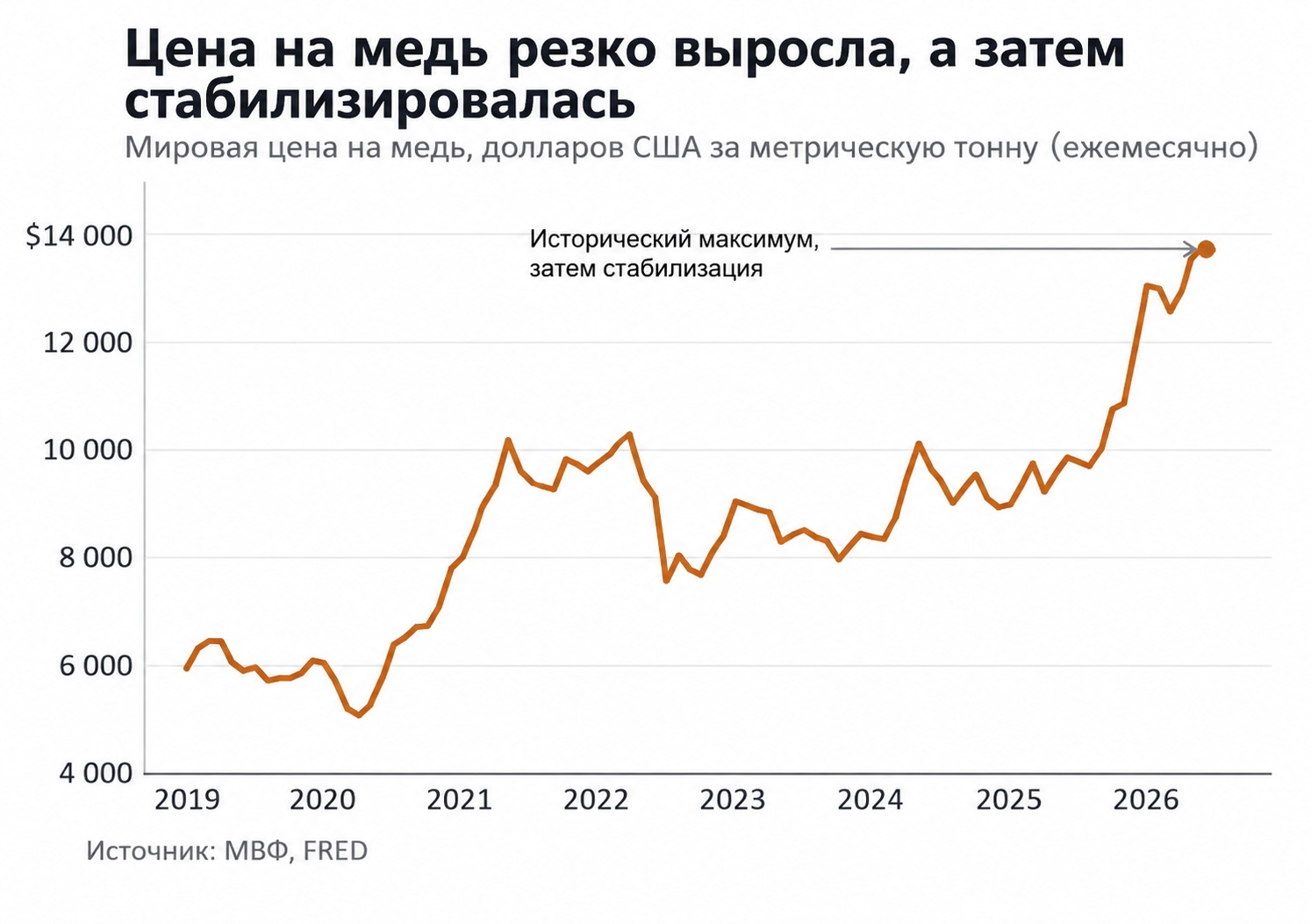
Chart: the dynamics of the world copper price since 2019. After a sharp increase in 2026, quotes reached an all-time high and moved to stabilization.
Why copper has risen in price so sharply
The current rally has several reasons at once.
1. Growing demand from AI and energy
Copper is needed for the construction of data centers, power grids, transformers, cooling systems and the production of equipment for artificial intelligence.
Additional demand is formed by:
electric vehicles;
renewable energy;
modernization of power grids;
construction of data centers;
industrial automation.
Unlike short-term speculative factors, these trends create structural demand for the metal for years to come.
2. Limited Offer
Copper production faces a number of challenges: declining ore quality, rising mining costs, delays in new projects and interruptions in individual deposits.
According to preliminary data from the International Copper Study Group, copper ore production in the first half of 2026 decreased by 1.1%, while concentrate production decreased by 2.6%.At the same time, the output of refined copper continued to grow, which shows an ambiguous picture between the extraction of raw materials and the final production of metal.
That is why the market can simultaneously face an excess of refined copper and a shortage of raw materials for further production.
China remains the main source of risk
China is the largest consumer of copper in the world, so the state of its industry directly affects quotations.
High prices have already begun to restrain demand from manufacturers and processing enterprises. According to SMM, on September 14, copper stocks in the main Chinese warehouses rose to 90,300 tons per week. At the same time, the indicator remains significantly lower than last year.
This is an important signal for the market.
On the one hand, low inventories confirm the limited supply available.On the other hand, the growth of warehouse balances and the caution of buyers may indicate that industrial demand does not keep pace with price growth.
It turns out a contradictory situation: the fundamental deficit persists, but the current cost of copper is already beginning to limit consumption.
US tariffs boosted speculative demand
An additional growth factor was expectations of possible US tariffs on imports of refined copper.
Against the background of uncertainty, the companies and traders began to redistribute supplies in advance in favor of the American market. This reduced the availability of the metal in other regions and increased price pressure.
However, the tariff theme simultaneously became a source of risk. If the new restrictions turn out to be less stringent than the market expected, some speculative positions may be closed.
This was already seen after the September all-time high: copper began to decline as market participants began to revise expectations regarding US trade policy.
Why copper growth may continue in the long run
Despite the current correction, the fundamental history of copper remains strong.
The world economy is gradually moving to a more energy-intensive infrastructure. This requires new power plants, transmission lines, battery systems, charging stations and data centers.
The main problem is that a new mine cannot be launched in a few months. It can take years between discovering a field, obtaining permits, building infrastructure and starting production.
Therefore, even a temporary decrease in demand does not eliminate the long-term supply problem.
However, this does not mean that the price will rise without stopping.After a rapid movement, the market may go into a phase of consolidation or a deep correction, especially if China shows weakness, and investors take profits.
What is important to track for traders
To assess the further movement of copper, several indicators should be monitored:
china's industrial data;
chinese copper reserves;
import of refined metal;
uS bond yields;
the dollar exchange rate;
decisions on American tariffs;
production reports of the largest copper companies;
demand from the energy and technological infrastructure.
Particular attention should be paid to the combination of price and inventory. If quotations are increasing at the same time as inventory balances are decreasing, this may indicate a limited supply. If the price rises and inventories begin to increase, the market becomes more vulnerable to a correction.
Avora Markets provides access to financial markets, allowing you to monitor the performance of commodity assets, currencies, and other instruments against the backdrop of changing macroeconomic conditions.
Key takeaway
Copper remains one of the key indicators of the global industrial cycle.Its growth is supported by investments in AI, electrification, and energy infrastructure, while limited supply creates a long-term foundation for demand.
At the same time, current levels already reflect a significant portion of positive expectations. China's weakness, rising inventories, and profit-taking could exacerbate short-term volatility.
The key question for the market is not whether the copper shortage has disappeared. It persists. The question is how quickly the current price will start to curb demand and whether supply can adapt to the new reality.