
Europe sharply increases demand for gold: ETF flows outpace the US
European investors have significantly increased their exposure to gold through ETFs in recent months - and the dynamics have especially accelerated since August.
According to the World Gold Council chart, accumulated gold ETF flows from the UK, France and Germany by the end of September 2026 reached approximately+125 tons, while American funds, after a deep decline, recovered only to about+15 tons.
This is an important change in the structure of gold demand.
Europe didn't just return to shopping. According to the World Gold Council, European gold ETFs received$3.6 billion in inflows in September alone, bringing purchases for the third quarter to record levels$14 billion. The UK was the main source of this movement: UK ETFs attracted$7.5 billion for the third quarter, which was their best quarterly result on record.
The main question arises:Why are European investors so actively buying gold right now?
And the answer may have less to do with the expectation of a rise in the price of gold, and more to do with a change in risk perception.
Briefly about the main thing
Europe:about+125 pointsaccumulated flows for the UK, France and Germany on a graph for 2026.
UK: +54 tinflows into gold ETFs in Q3 alone.
European ETFs: +$14 billionfor the third quarter - a record quarterly result.
USA:about+15 ton the presented graph after falling to almost −100 tons earlier in the year.
Global ETFs: +$10 billioninflux in September and+$31 billionfor the third quarter.
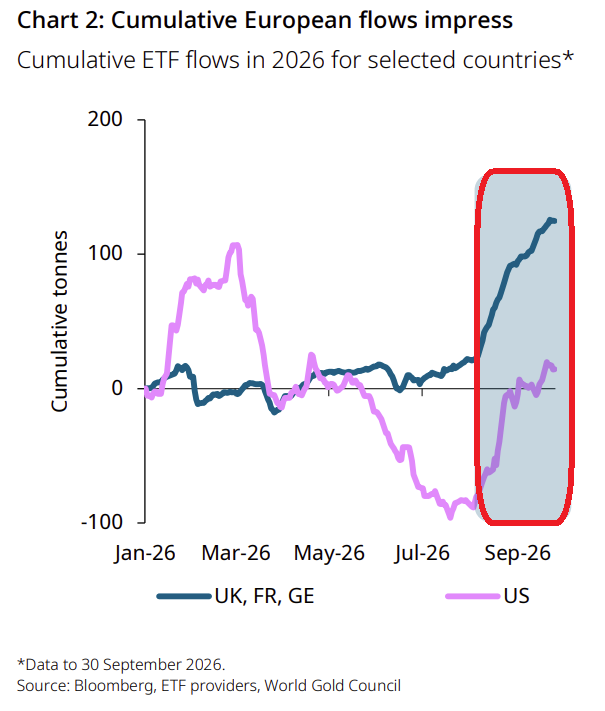
European gold demand accelerated sharply in the second half of 2026.Cumulative gold ETF flows from the UK, France and Germany reached around 125 tonnes by the end of September, while US flows only recovered to around 15 tonnes after a deep decline. Source: Bloomberg, ETF providers, World Gold Council; data through September 30, 2026.
What happened to European demand for gold?
The main change occurred in the third quarter.
After relatively weak performance in the first half of the year, European investors began to significantly increase their positions through gold ETFs. The UK especially stands out.
According to the World Gold Council, UK gold ETFs have attracted54 tons of gold for the third quarter, and inflows were observed in12 of 13 weeks until September 25.
This sequence is especially important.
A single large inflow could be related to a specific event, a rebalancing of portfolios, or a short-term market opportunity. But sustained buying throughout almost the entire quarter looks more like a change in investor behavior.
At the same time, the World Gold Council model, based on the historical relationship of British flows with flows in the USA and Europe without the UK, assumed approximately18 tonsinflows into UK ETFs in the third quarter.
It was actually recorded54 tons.
The difference is about36 tons.
It is this anomaly that makes the current situation particularly interesting.
Why might investors buy gold now?
It is important to separate fact and interpretation here.
Fact:European ETFs are indeed showing strong inflows.
World Gold Council Interpretation:One possible reason could be changing perceptions of fiscal risks, inflation and government bond yields.
Government bond yields have remained elevated in recent months. For an investor, this creates a mixed picture.
Typically, a higher bond yield increases the opportunity cost of holding an asset that does not generate a coupon.
This is a potentially negative factor for gold.
But if rising yields are perceived not as a consequence of stronger economic growth, but as compensation for increased fiscal or inflation risk, the reaction may be completely different.
High bond yields then become less an alternative to gold and more a signal that investors are demanding a larger premium for long-term government debt.
And this is a fundamentally different market mechanism.
The UK is at the center of the movement
It is the British market that now looks the most unusual.
In July 2026, the Office for Budget Responsibility published a further report on the long-term sustainability of UK public finances.
The OBR notes that in most of the scenarios considered, public debt is on an unsustainable upward trajectory over the long term, and earlier fiscal adjustment would be less costly than delaying such measures. At the same time, the organization itself emphasizes the high uncertainty of long-term scenarios.
This does not mean that the UK is on the verge of an immediate debt crisis.
But the mechanism itself is important for the financial market.
If investors begin to demand a higher premium for long-term government bonds, this may be reflected in the growthterm premium— the additional return that investors require for holding long-term debt.
And this is where the interesting connection with gold comes into play.
The World Gold Council notes that since July, excess flows into UK gold ETFs have begun to move in tandem with the rise in the UK term premium. Previously, this relationship was much weaker.
This does not yet prove cause and effect.
But it shows market participants may be looking at gold as part of a hedge against a more complex combinationfiscal risk, inflation uncertainty and increased long-term financing costs.
Why is this important for gold?
Gold has traditionally been viewed as an asset that can be used to diversify a portfolio and protect against certain types of macroeconomic and financial risk.
However, the current situation is interesting for another reason.
In September, the price of gold fell by8.5% per month, up to approximately$4,176 per ounce.
At the same time, global gold ETFs attracted about$10 billion, or67 tons, despite the price reduction.
This is an unusual combination.
The price falls - and physically backed ETFs continue to receive capital inflows.
In other words, capital flow and price dynamics in September did not move as one would expect with the simple logic of “investors sell gold - the price falls.”
This highlights the importance of separating multiple different markets within a single asset.
Futures positions, ETF flows, physical demand and dollar dynamics can move in different directions.
Europe versus the USA: is the structure of demand changing?
The presented graph shows the discrepancy especially clearly.
American flows deteriorated sharply at the beginning of the year and approached the level−100 tons. Then they recovered.
The European dynamics were different.
After a period of weakness, flows from Britain, France and Germany began to accelerate, especially in August and September.
And this is not just a local British phenomenon.
The World Gold Council notes that European gold ETFs gained$3.6 billion, and the influx was quite wide: in addition to the UK, noticeable purchases were also observed through funds registered in France and Germany.
In the third quarter, Europe attracted$14 billion, exceeding North America's$12 billion.
This was the first quarter with positive flows in both regions since the second quarter of 2021, when Europe surpassed North America in inflows.
Thus, we are no longer just talking about a few large European funds.
A broader change in the structure of investment demand is taking shape.
Why gold?
Gold has several characteristics that become particularly interesting in an environment of heightened uncertainty.
1. Absence of credit risk of the issuer
Gold is not a liability of a government or corporation.
This distinguishes it from government bonds and corporate debt.
2. Diversification
Gold can be used as a separate component of a portfolio, the dynamics of which do not completely coincide with the behavior of stocks and bonds.
3. Protection against certain macro risks
Investors can use gold as a diversification tool during periods of inflation uncertainty, currency risks or heightened geopolitical tensions.
But it is important not to turn these properties into a universal statement.
Gold is not a guaranteed hedge against falling markets.
September 2026 showed this well: gold declined despite strong inflows into ETFs.
Historical context: why you shouldn’t just compare the situation now with 2022
The parallel with the British government bond crisis of 2022 suggests itself.
But the World Gold Council emphasizes an important distinction.
In 2022, the rise in UK government bond yields has been linked to localized stress in the gilt market.
Now the movement in yields is broader.
That is, the issue is no longer only in the UK.
The growth of term premium is also observed in other developed markets, and European investors are simultaneously increasing their exposure to gold.
It is therefore more appropriate to view the current situation as a potentially broader shift in risk perception.
Not a “repeat of 2022”, butanother market environment with a similar element - increased attention to the cost of government funding.
What to track now?
1. European government bond yields
If yields continue to rise, it will be important to understand the reason for the move.
Growth due to stronger economic growth and growth due to an increase in the fiscal premium are two completely different scenarios.
2. Term premium
Particularly interesting is the dynamics of the long-term premium on government bonds.
If it continues to rise in tandem with inflows into gold, the current relationship will become more meaningful.
3. European gold ETF flows
The main question is whether the buying pattern will continue after the record third quarter.
It is the stability of flows that will be more important than one strong month.
4. US ETF flows
The US gold market remains the largest component of Western investment demand.
Continued recovery from the dip to almost −100 tonnes will be an important indicator of global appetite for gold.
5. US dollar
A strong dollar can put pressure on the price of gold in dollar terms.
Therefore, it is better to analyze gold dynamics simultaneously with DXY and Treasury yields.
6. Positioning in the futures market
ETF flows and futures positioning may be moving in opposite directions.
That's exactly what happened in September: inflows into ETFs were accompanied by a noticeable decline in managed cash positions on the COMEX.
Three scenarios for the gold market
Scenario 1 - European demand continues
If European ETFs continue to see robust inflows and fiscal and inflation risks remain a focus, gold demand could remain supported.
This is especially important if high bond yields continue to be perceived by investors as compensation for rising long-term risks.
Scenario 2 - flows return to normal
If European demand growth turns out to be largely the result of portfolio rebalancing, a strong third quarter could be followed by a slowdown.
In this case, record flows will be more of an episode than a new sustainable trend.
Scenario 3 - Global demand expands
If Europe is joined by more robust demand from the US and Asia, the movement could become more global.
In this case, it will no longer be important only what happens in British ETFs, but the synchronization of flows between the main regions.
None of these scenarios are guaranteed predictions.
Main conclusion
The most interesting story right now isn't just that Europeans are buying more gold.
Much more importantwhythey do it.
The UK, France and Germany are seeing a sharp acceleration in flows into gold ETFs, with the UK market becoming the main source of European movement. However, global gold ETFs continued to receive large inflows even in a month when the price of gold declined.
This may indicate a change in the perception of gold.
Investors may view it not only as a bet on price growth, but also as a piece of portfolio protection in an environment where there is simultaneously increased scrutiny of government debt, inflation risks, bond yields and geopolitical uncertainty.
As long as it remainsinterpretation, rather than a proven causal mechanism.
But this is precisely why European ETF flows are becoming one of the indicators to watch closely in the fourth quarter of 2026.