
The Iranian rial has fallen to a historic low: why a new escalation could worsen the currency crisis
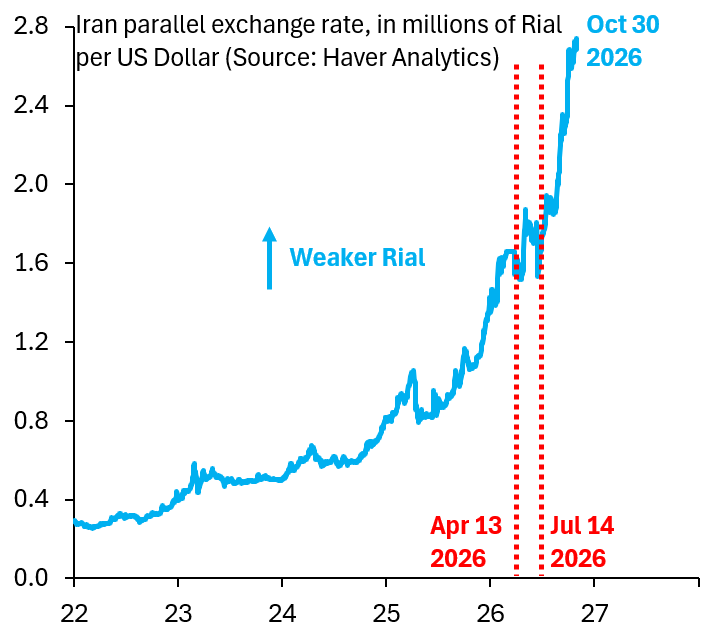
The Iranian rial continues to rapidly lose value. By October 30, 2026, the parallel rate approached 2.8 million rials per dollar, reaching a new historical low according to the Haver Analytics chart.The next weakening of the currency occurs at a time when the country’s economy is simultaneously faced with sanctions pressure, restrictions on oil exports and the threat of a new round of military conflict with the United States.
The situation is especially sensitive due to the uncertainty surrounding diplomatic negotiations.The mediators are trying to restore dialogue between Washington and Tehran, but the possibility of resuming a large-scale military operation remains a significant risk.
For the foreign exchange market, this means that pressure on the rial could continue even without a new military strike. The economy is already experiencing the effects of limited access to international trade, reduced foreign exchange earnings and high inflation.
The main question is whether the Iranian economy can stabilize the foreign exchange market at a time when foreign trade prospects are simultaneously deteriorating and geopolitical uncertainty is growing.
Briefly about the main thing
By October 30, the parallel exchange rate of the Iranian rial approached 2.8 million per dollar. Since the beginning of October, the national currency has continued to make new lows, and the gap between the official and market rates remains significant. Additional pressure is created by American sanctions and restrictions on oil exports.At the same time, Washington is considering the possibility of resuming large-scale military operations after the midterm elections in the United States if diplomatic efforts do not lead to an agreement. However, negotiations mediated by regional states continue, so further escalation remains a scenario and not a fait accompli.
The Iranian rial approached 2.8 million per dollar
The presented chart demonstrates the long-term trend of weakening of the Iranian currency.
At the beginning of the period shown, the dollar was valued at approximately 280 thousand rials. Then the rate gradually rose above 500 thousand, after which the acceleration of devaluation became especially noticeable in 2025–2026.
During 2026, the movement became significantly sharper. There are two time reference points on the chart: April 13 and July 14.After these marks, the foreign exchange market continued to demonstrate increased volatility, and the value of the dollar relative to the rial increased sharply.
By October 30, the figure approached 2.8 million rials per dollar.
It is important to understand that we are talking about a parallel, or free, foreign exchange market. There are various exchange rates in Iran, including official regulated levels and market quotations. Therefore, the value on the chart cannot be automatically compared with the official rate of the Central Bank.
The difference between them is itself an important economic indicator: the more the official and market valuations of a currency diverge, the more difficult it is to use the administrative exchange rate to understand the real purchasing power of the population and business.
Why does the Iranian currency continue to depreciate?
The fall of the rial cannot be explained solely by expectations of new American strikes. The currency crisis was formed under the influence of several interrelated factors.
1. Sanctions and reduction in foreign exchange earnings
The Iranian economy is significantly dependent on energy exports.Oil revenues provide the state with the most important source of foreign currency needed for international payments, import of goods and maintenance of the financial system.
When sanctions restrict the ability to sell oil, transport it, and receive payment, the domestic supply of foreign currency is reduced.
This creates a fundamental problem for the national currency.
Importers need dollars to purchase equipment, raw materials, medicines and other goods. The population needs foreign currency to maintain savings.To the state - to service external obligations and finance international purchases.
When access to dollar liquidity is limited, competition for foreign exchange increases.
As a result, the market value of the dollar rises, and the rial continues to lose purchasing power.
2. US naval blockade increases economic pressure
An additional factor was the American economic pressure campaign, including restrictions on maritime trade and oil exports.
According to a US Treasury report released on October 30, the restrictions affected not only Iran's oil revenues, but also the broader international trade infrastructure.
Problems arise in several directions:
Limitation of oil exports and access to proceeds.
Difficulties using international banking networks.
Obstacles to alternative overland trade routes.
Restrictions in the field of commercial aviation.
Strengthening control over financial channels used to circumvent sanctions.
The last factor is especially important. Even if a country finds an alternative route to export goods, this does not guarantee the ability to freely receive payment, convert the proceeds and use it for international payments.
Thus, the pressure extends not only to the state budget, but also to the ability of private businesses to conduct foreign economic activity.
3. Inflation undermines confidence in the national currency
The weakening of the rial comes amid extremely high inflation.
Iran's annual inflation reached 90% in September 2026, according to a US Treasury report published in late October. At the beginning of 2025, the figure was approximately 35%.
This dynamic means a rapid decline in the purchasing power of the national currency.
For the general population, the consequences are especially noticeable:
Everyday goods are becoming more expensive.
Savings in rials lose real value faster.
Imported goods are becoming less available.
It is more difficult for businesses to plan expenses and set prices.
The demand for alternative ways to preserve capital is increasing.
In conditions of high inflation, foreign currency and gold become an alternative for the population to national monetary savings.
This creates additional demand for the dollar and increases pressure on the rial.
Why could a new military conflict accelerate the fall of the rial?
The geopolitical situation remains one of the most important factors for assessing the further dynamics of the Iranian currency.
On October 28, Axios reported that regional mediators led by Qatar were trying to push for a resumption of negotiations between the US and Iran. The goal of diplomatic efforts is to prevent a new large-scale military operation after the midterm elections in the United States.
The publication noted that without reaching an agreement, the resumption of large-scale strikes could become a likely scenario.
This is not just about continuing sanctions pressure. The military scenario being discussed potentially affects Iran's energy, nuclear, infrastructure and government facilities.
For the foreign exchange market, such uncertainty creates several additional risks.
Worsening economic expectations
If the likelihood of further shocks increases, companies and the public may begin to proactively consider the possible deterioration of the economic situation.
Businesses are becoming more careful with investments, imports and long-term contracts. The population seeks to protect savings from further depreciation.
This could lead to additional demand for the dollar even before the actual start of the military operation.
Risks for the oil sector
Oil infrastructure is of strategic importance to the Iranian economy.
Any new damage to production, processing or transportation facilities could further limit the country’s export capabilities.
Even without physical damage to infrastructure, military escalation can increase the cost of logistics, transportation insurance, and international operations.
For an economy that is already experiencing problems receiving foreign exchange earnings, such a development will become an additional source of pressure.
Growing demand for protective assets within the country
During serious geopolitical crises, people and businesses often seek to reduce their dependence on the national currency.
In the case of Iran, this mechanism is especially important since confidence in the rial has already been weakened by prolonged devaluation and high inflation.
If expectations of further depreciation increase, demand for the dollar and gold could increase.
Thus, even the expectation of military escalation can affect the foreign exchange market.
Negotiations between the US and Iran: why is the military scenario not yet a foregone conclusion?
Despite the high level of tension, the diplomatic process continues.
On October 30, a Pakistani military spokesman said Islamabad was cautiously optimistic about the prospects for mediation between Washington and Tehran.
Pakistani Field Marshal Asim Munir visited Tehran twice during October. During his last trip, he was accompanied by representatives of Saudi Arabia and Turkey.
In parallel, diplomatic efforts are supported by Qatar and other regional states.
One of the options being discussed involves returning to the mechanism of cooperation between Iran and the International Atomic Energy Agency.As part of a possible agreement, inspections of nuclear facilities are being discussed in exchange for some easing of sanctions restrictions.
However, significant differences remain between the parties.
Washington is seeking concessions on Iran's nuclear program. Tehran, in turn, is interested in lifting restrictions, easing the naval blockade and unlocking frozen financial assets.
That is why negotiations cannot yet be considered a guarantee of de-escalation.
A contradictory situation is emerging for the foreign exchange market: on the one hand, there is the possibility of a diplomatic solution, on the other, the risk of a new military confrontation remains.
How could Iran's currency crisis affect global markets?
The fall of the rial in itself does not pose a direct systemic threat to the global financial system.The economic significance of the situation is determined primarily by its connection with the energy market and regional security.
Oil and energy markets
The main channel of potential influence is the oil sector.
Iran remains a significant participant in the energy market, and the geography of the conflict makes the situation particularly sensitive for supplies through the Persian Gulf.
Of particular importance is the Strait of Hormuz, through which approximately a fifth of the world's oil and gas trade passed before the conflict.
If military escalation leads to additional shipping restrictions, the market could see a higher geopolitical premium in oil prices.
The geopolitical premium is an additional component of the cost of raw materials that market participants include due to the risk of supply disruptions.
At the same time, an increase in oil prices is not guaranteed: prices are also affected by global demand, supply from other producers and reserves.
US dollar
If the conflict escalates further, the dollar may receive support due to demand for liquidity and protective assets.
However, the reaction of the US currency will depend on the scale of the conflict, expectations regarding the Fed's monetary policy and the general state of world markets.
Gold
Gold may also be the focus of investors' attention.
Increased geopolitical uncertainty may increase interest in the precious metal as a store of value.
But gold's dynamics are not determined solely by geopolitics. Real interest rates, the dollar exchange rate and demand from central banks also play a significant role.
Regional markets
The greatest sensitivity to further developments of the situation can be observed in the economies of the Middle East.
Investors will be assessing not only military risks, but also the possible implications for trade routes, energy infrastructure, international investment and financial flows.
What could happen next: three scenarios for the Iranian rial
The further movement of the national currency will depend on a combination of political, economic and military factors.
Scenario 1: Resumption of large-scale US strikes
This is the most negative scenario for the Iranian economy.
If diplomatic talks fail and hostilities resume, the rial could face a new wave of devaluation pressure.
Additional restrictions on oil infrastructure, trade routes and financial transactions could further reduce the supply of foreign exchange.
In this case, the population and business can accelerate the transition to the dollar and gold.
However, it is impossible to predict the exact scale of the possible exchange rate movement.
Scenario 2. Continued sanctions pressure without a new large-scale operation
Even without a resumption of intense military action, Iran's economic problems will not go away.
The continuation of the blockade, export restrictions and problems with international payments will continue to create structural pressure on the national currency.
In this scenario, the rial could remain volatile and inflation could continue to erode domestic demand and purchasing power.
Scenario 3: Diplomatic agreement and partial de-escalation
A positive scenario involves reaching agreements between the United States and Iran.
If the parties can agree on terms for resuming negotiations, limited sanctions relief and a resumption of international economic engagement, pressure on the currency could ease.
A recovery in export earnings and improved expectations could support the rial.
However, even a diplomatic agreement does not guarantee a quick recovery of the national currency. This will require a more sustained improvement in economic conditions, a restoration of confidence and a normalization of foreign trade flows.
What should investors watch now?
To assess the further development of the currency crisis, it is important to monitor not only the rial quotes, but also several related indicators.
1. Parallel USD/IRR rate
This is one of the clearest indicators of market expectations within Iran. Continuing to update highs in the dollar will indicate continued devaluation pressure. Stabilization of the exchange rate may indicate a weakening of panic sentiment, although in itself it does not mean economic recovery.
2. Difference between official and parallel courses
This indicator helps to assess the scale of currency imbalances. The widening gap means that the administrative assessment of the rial is increasingly diverging from the market one.
3. Iran's oil exports
Export volumes and the actual ability to receive payment for supplies have a direct impact on the country’s foreign exchange earnings. Additional restrictions could increase foreign currency shortages.
4. Status of American naval blockade and sanctions
Changes in trade and financial restrictions will be an important signal for assessing the prospects of the Iranian economy.
5. Diplomatic negotiations
Any agreements between the US and Iran could significantly change market expectations. It is especially important to monitor the mediators' statements, the terms of a possible agreement, and the parties' willingness to compromise.
6. Brent and the situation in the Strait of Hormuz
Oil prices and shipping safety allow us to assess whether the regional conflict is beginning to create additional risks for the global energy market.
Key Takeaway: Iran's Currency Crisis Goes Beyond Normal Devaluation
The rate approaching 2.8 million rials to the dollar reflects the depth of economic pressure Iran faces.
It is important that the currency crisis does not develop due to one event.It is shaped by sanctions, restrictions on oil revenues, high inflation, international trade problems and declining confidence in the national currency.
A possible resumption of American strikes could exacerbate existing problems, but the diplomatic process remains an alternative to military escalation.
For global markets, the key factor will be not so much the dynamics of the Iranian rial itself, but rather its connection with oil supplies, the security of the Strait of Hormuz and the general geopolitical situation in the Middle East.
That is why what is happening deserves attention far beyond the Iranian currency market.