
Korean shares are losing their main support: why KOSPI came under pressure
The South Korean stock market finds itself at an unusual point: selling pressure is intensifying at a time when one of the most important sources of demand is all but disappearing.
On Thursday, October 8, the KOSPI index collapsed by2.62% to 6,625.93 points, and foreign investors sold approximately 1.99 trillion won in shares. Institutional investors were also net sellers of about 1.67 trillion won.
At the same time, the fundamental background for Korea's largest technology companies looks paradoxically strong.Samsung Electronics yesterday presented preliminary results for the third quarter, according to which operating profit could reach a record107.4 trillion wonamid booming demand for memory and AI infrastructure.
But the market failed to use this news as support.
And here lies the main question:
If even Samsung's record results cannot stop sales, what will happen to KOSPI after corporate demand finally disappears?
Briefly about the main thing
KOSPI:6,625.93 points after falling by2,62%October 8.
Foreign investors:about−1.99 trillion wonfor the session on October 8.
Institutional investors:about−1.67 trillion won.
Corporate buybacks:about+$27 billionaccumulated demand for the four weeks leading up to September 22, according to Goldman Sachs data in the chart presented.
Retail investors:about−$18 billionfor the same period.
Foreign investors:about−$10 billionfor the same period.
The main feature of these figures is that the corporate buyback actually compensated for a significant part of the sales of other groups of investors.
Now this compensation is weakening.
The Korean market has lost its main buyer
At first glance, the capital flow chart looks like a typical story about a weak stock market.
Foreign investors were selling.
Retail investors were selling.
The index was under pressure.
But one line on the graph is fundamentally different from the rest.
Buyback.
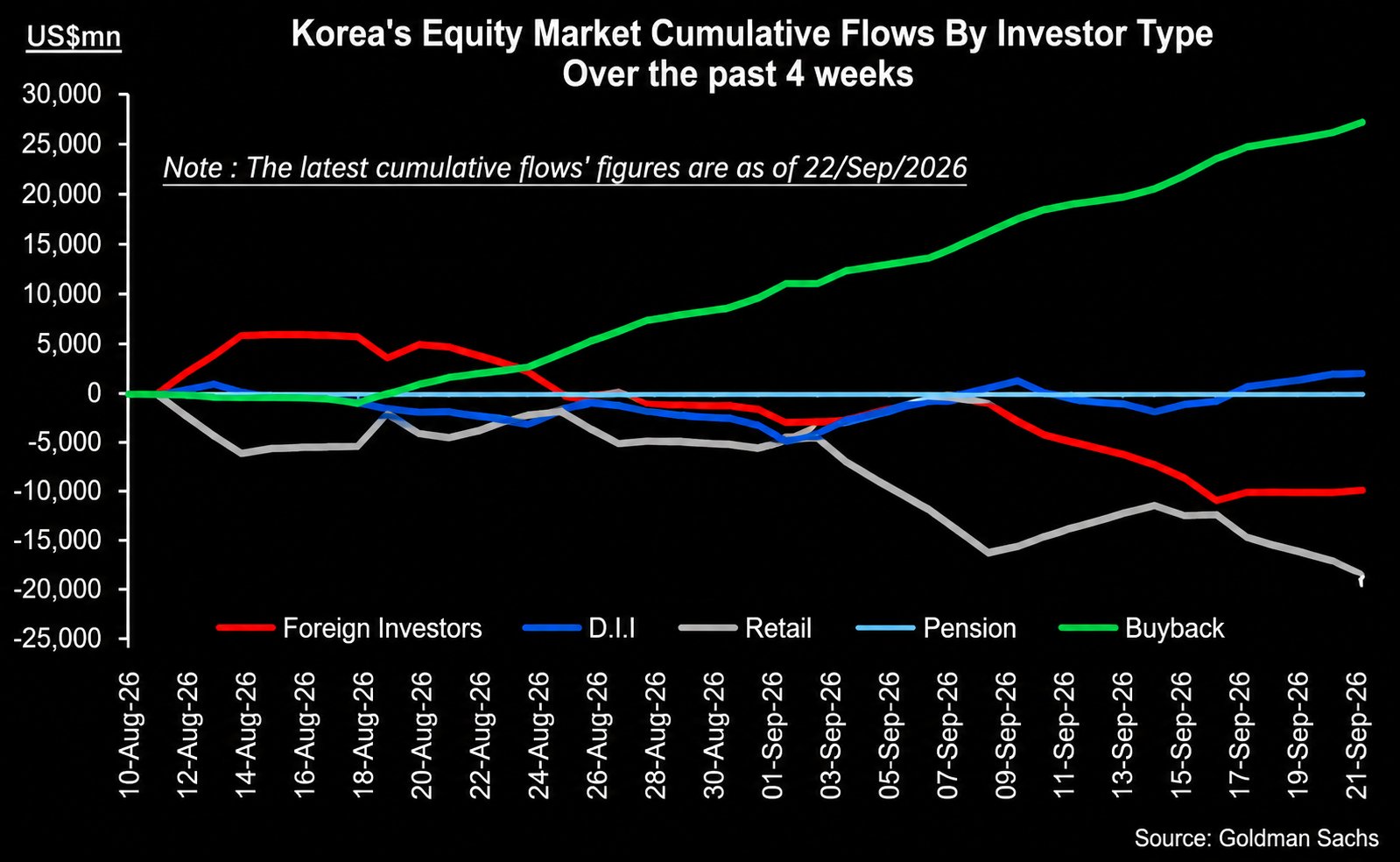
Source: Goldman Sachs The graph shows accumulated flows by type of investor in the Korean stock market over four weeks; The latest data on the chart is September 22, 2026.
On the chart, corporate buybacks increased to approximately$27 billion, while retail investors formed about$18 billion in sales, and foreign ones - about$10 billion in sales.
That is why buyback has become a kind of shock absorber for the market.
While companies were actively buying back their own shares, the market received an additional source of demand, which partially absorbed supply from other categories of investors.
The problem is that this source of demand turned out to be temporary.
Why completing buyback programs is so important for KOSPI
Buyback is a company’s repurchase of its own shares from the market.
When a large company buys its shares, it becomes a direct participant in the market and creates additional demand.
In the case of South Korea, we are not talking about small companies.
Samsung Electronics and SK Hynix are the largest representatives of the Korean market and at the same time key components of KOSPI.
Their buyback programs have been one of the factors supporting the market in recent weeks.
Back in September, Seoul Economic Daily noted that Samsung and SK Hynix could complete their programs much earlier than the original deadlines.
Then this began to happen in practice.
Samsung Electronics completed the initially planned repurchase volume ahead of schedule. By October 1, the company had acquired approximately53.8 million own sharesfor the amount of approximately14.16 trillion won, exceeding the initial target volume.
SK Hynix was also rapidly approaching the end of its program.
Thus, the market is faced with a simple problem:
the buyer who used to absorb a significant amount of supply gradually disappears.
The most interesting: fundamental news is not saving the market yet
The situation becomes even more unusual against the backdrop of Samsung's results.
The company expects record quarterly operating profit of approximately107.4 trillion won, which is almost nine times more than a year earlier. The main driver remains the high demand for memory, associated, among other things, with the development of AI infrastructure.
The logic for the market might be obvious:
strong results → strong earnings expectations → demand for shares → support for KOSPI.
But the opposite happened.
On Thursday, shares of Samsung Electronics fell by about2,42%, and SK Hynix lost about2,44%. At the same time, the KOSPI fell 2.62%.
This is an important signal.
It shows that the short-term dynamics of the Korean market are now determined by more than just corporate performance.
Capital flows and investor positioning can be as important as earnings themselves.
Foreign investors increase pressure
Sales to foreign investors have become one of the most visible problems for KOSPI.
On October 8, foreign investors sold approximately1.99 trillion won, and institutional ones - approximately another1.67 trillion won.
There were other technical events occurring simultaneously in the market—ETF rebalancing and options expiration—which also added pressure on liquidity and supply.
This produces a peculiar effect:
there are more sellers → the corporate buyer disappears → the market becomes more sensitive to each new wave of sales.
This is what makes the current market structure potentially more vulnerable.
KOSPI is already well below its June peak
Another important element of the picture is the scale of the previous movement.
After reaching June highs, the Korean market retreated significantly. To the current level, KOSPI is approximately29% below June peak, which already corresponds to a deep decline relative to the previous maximum.
However, such a fall cannot automatically be considered evidence of the beginning of a new long-term bear market.
The market can move according to several scenarios.
But the sheer scale of the decline shows how dramatically the relationship between supply and demand has changed.
Why $27 billion buyback is so important
The main value of the statistics presented by Goldman Sachs lies not only in the size of individual flows.
She showsdemand structure.
Four weeks before September 22:
Investor type | Cumulative flow |
|---|---|
Corporate buybacks | ≈ +$27 billion |
Retail investors | ≈ −$18 billion |
Foreign investors | ≈ −$10 billion |
That is, the two largest sources of sales together formed about$28 billion negative flow, while corporate buybacks provided approx.$27 billion in demand.
It's almost a mirror design.
While it worked, the market could withstand much more selling pressure.
But if corporate demand disappears, the old balance sheet changes.
And this is perhaps the main conclusion from the graph.
What happens after a buyer disappears?
Let's imagine the market as a regular auction.
There are sellers who are ready to sell shares at current prices.
And there are buyers ready to absorb this volume.
If there are fewer buyers, sellers have to lower the price to find new demand.
This is why the end of buyback programs can be significant even without the emergence of a new negative fundamental factor.
It is not necessary for sales to skyrocket. It is enough for the buyer who previously absorbed these sales to disappear.
This is fundamentally different from the classic scenario of a collapse caused by one piece of bad news.
Here we are talking primarily aboutchange in market flows structure.
But this does not mean an automatic continuation of the fall.
It is important not to draw too direct a conclusion.
The disappearance of buyback support does not mean that the KOSPI will necessarily continue to decline.
There are several possible scenarios.
Scenario 1 - the market finds a new buyer
If foreign investors return to buying and strong results from semiconductor companies begin to lead to upward revisions to earnings forecasts, new demand could offset the disappearance of buyback.
In this case, the current weakness may turn out to be a phase of redistribution.
Scenario 2 - sales continue, but the market stabilizes
Corporate demand is fading, but the valuations and strong fundamentals of the largest companies are attracting buyers at lower levels.
In this case, the KOSPI may move from a falling phase to a phase of high volatility and consolidation.
Scenario 3 - vacuum of demand occurs
The most vulnerable scenario is that foreign and institutional sales continue without a major new source of demand emerging.
Then the market becomes much more sensitive to negative news.
It is this scenario that is now worth monitoring especially carefully.
Why Samsung and SK Hynix matter
The Korean market is closely linked to the semiconductor sector.
Therefore, the situation around Samsung Electronics and SK Hynix is simultaneously the story of individual companies and the story of the entire KOSPI.
The contrast between fundamental results and stock performance is particularly important.
Samsung may post record profits while the market declines.
This means that investors are currently assessing more than just current earnings.
They are trying to understand:
How stable is AI-driven demand;
how long will the memory deficit last?
how high chip prices will remain;
whether Samsung will be able to increase its position in HBM;
how strong the Korean won will affect export earnings;
and, most importantly, who will buy shares after the completion of large buyback programs.
Reuters notes that forecasts for Samsung have already been adjusted against the backdrop of more moderate growth in chip prices and the strengthening of the won, despite continued strong AI demand.
Thus, record earnings alone do not guarantee continued growth in stocks.
What to track now?
1. Flows of foreign investors
This is one of the main indicators.
If foreign sales begin to decline or are replaced by purchases, this will be the first sign of a new source of demand.
If sales continue, pressure on KOSPI may remain high.
2. Buyback Samsung Electronics
The main question is how quickly and completely the additional corporate demand will disappear.
Samsung has already completed the initially stated scope of the program ahead of schedule.
3. Buyback SK Hynix
The next important element is the completion speed of the SK Hynix program.
The sooner it ends, the faster the market will lose another source of systemic demand.
4. Samsung Electronics and SK Hynix
It is important to monitor not only the share price, but also the market reaction to financial results.
If strong earnings stop driving sales and start attracting buyers, the structure of the market may change.
5. KOSPI relative to June peak
The percentage of reduction in itself does not provide a forecast.
But it helps to assess the scale of the movement that has already occurred and understand how much investor sentiment has changed.
6. Trading volumes
If the decline is accompanied by growing volumes, this indicates high activity of market participants.
If the market falls on gradually decreasing volumes, the structure of the movement may be different.
Main conclusion
The story of the Korean stock market is not now about whether Samsung and SK Hynix are performing well or not.
Something else is much more interesting:
who will be the buyer?
In recent weeks, corporate buybacks have become one of the largest sources of demand for Korean stocks. In the four weeks leading up to September 22, corporate buybacks amounted to about$27 billion, practically offsetting the combined sales of foreign and retail investors.
Now this source of support is rapidly dwindling.
Samsung has already completed the bulk of its program, and SK Hynix is also in the final stages.
At the same time, foreign and institutional selling intensified, and on October 8, the KOSPI lost another 2.62%.
This is not a guarantee of further decline.
But this means thatthe market will now have to independently search for a new source of demand.
That is why in the coming weeks it is worth looking not only at earnings and macroeconomics, but also atwho actually buys korean stocks.
Because when the largest buyer disappears, the structure of the market can change faster than its fundamentals.