
Swiss franc against the euro: why the SNB is ready to tolerate a strong currency
The Swiss franc may receive a new impulse to strengthen against the euro. The reason is a change in the inflation picture in Switzerland and a gradual revision of expectations regarding the monetary policy of the Swiss National Bank (SNB).
In October, annual inflation in the country accelerated to 1.5% versus 1.0% in September.Against this background, SNB Vice Chairman Antoine Martin said that the regulator is closely monitoring possible secondary inflationary effects.
This is an important signal for the foreign exchange market. If inflation pressures continue to increase, maintaining zero interest rates may become less justifiable.
ING analysts do not expect a rate increase as early as December, but note that the market is pricing in two increases by September 2027. Another important point: according to ING, the SNB may become more tolerant of the strengthening of the franc.
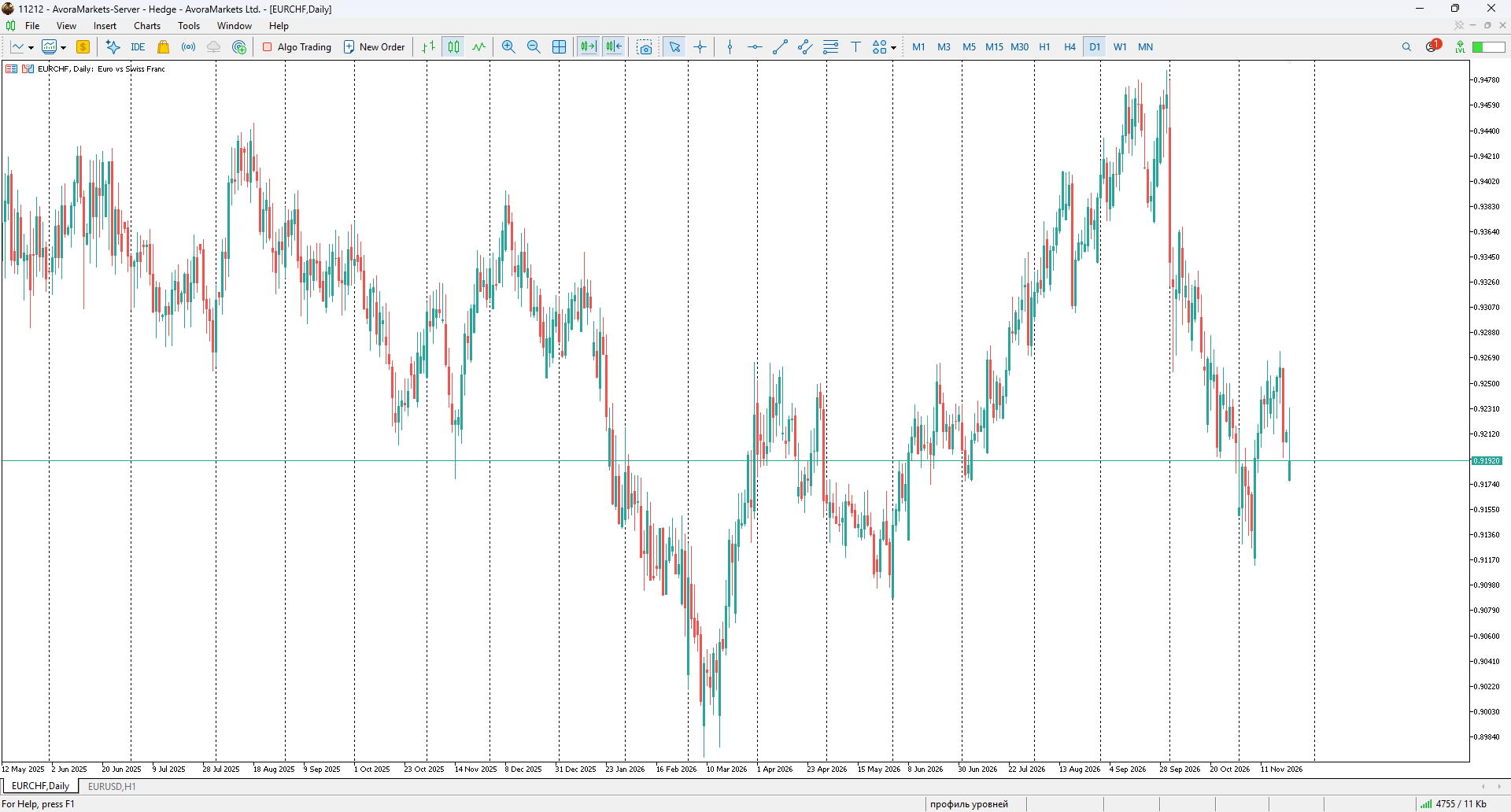
Against this background, EUR/CHF may face additional pressure. ING expects the 0.9125 level to be retested in the coming weeks.
What's happening with the SNB's monetary policy?
At the last published decision on September 24, 2026, the Swiss National Bank kept the interest rate at 0%.
This decision was made in an environment of relatively moderate inflation and limited medium-term price pressure.
However, subsequent statistics began to change the picture.
In October, consumer inflation in Switzerland accelerated to 1.5% in annual terms. For comparison: in September the figure was 1.0%.
At the same time, inflation is still within the SNB target range, which is 0-2%.
The problem is not so much the current price level as the possible further acceleration of inflation.
SNB Vice Chairman Antoine Martin drew special attention to the so-called secondary inflationary effects.
We are talking about a situation where the initial increase in individual prices gradually spreads to other goods and services.For example, increases in energy costs can lead to increases in transportation costs, production costs and final consumer prices.
If such a process takes hold, the central bank may need to tighten monetary policy.
That is why the market is beginning to more carefully assess the likelihood of future rate increases.

Why is the strengthening of the franc no longer a problem for the SNB?
The most interesting part of the current situation relates to the attitude of the Swiss regulator towards its own currency.
Historically, the SNB has been quite attentive to excessive strengthening of the franc.
Switzerland is a small, open economy focused on international trade.A national currency that is too strong can impair the competitiveness of exporters, reduce the attractiveness of Swiss goods for foreign buyers and create additional difficulties for business.
In addition, a strong franc can reduce the cost of imported goods, which puts additional pressure on inflation.
However, in conditions of accelerating inflation, this mechanism can work in favor of the regulator.
A stronger national currency makes imports cheaper and helps curb rising consumer prices.
It is this nuance that ING draws attention to.
Bank analysts believe that the SNB may become increasingly tolerant of the strengthening of the Swiss franc. Currency itself can be an important element of the monetary conditions of a small open economy.
This does not mean that the SNB has officially announced its intention to maintain an endless strengthening of the franc.The regulator remains responsible for price stability and retains the possibility of currency interventions.
But the attitude towards a strong currency may change depending on the inflation situation.
The Swiss franc is once again a safe haven asset
The currency is further supported by its status as one of the main protective instruments in the international foreign exchange market.
When investors face increased uncertainty, they often reallocate capital to assets and currencies that are perceived as more stable.
The Swiss franc traditionally belongs to such currencies.
In October, the franc strengthened noticeably against the backdrop of several factors:
Increased volatility in financial markets due to uncertainty surrounding the AI sector.
Rising energy prices.
Concerns about the state of French public finances.
General increase in demand for protective assets.
Antoine Martin separately emphasized that the franc still has a strong status as a safe haven currency.
This is important for the foreign exchange market: demand for the franc may rise not only because of interest rates, but also as a result of changes in global risk attitudes.
As a result, fundamental support for CHF is being formed in several directions at once.
Why might EUR/CHF continue to decline?
The EUR/CHF currency pair shows the value of one euro in Swiss francs.
This means that the decline in the quote reflects the relative strengthening of the franc against the euro.
For example, if the pair moves from 0.9250 to 0.9125, the market offers less and less Swiss francs for one euro.
In the current situation, several factors are potentially working against EUR/CHF.
First, inflation in Switzerland is accelerating, raising the prospect of tighter SNB policy.
Secondly, the franc receives additional support due to its status as a defensive asset.
Third, the SNB's willingness to be more tolerant of a strong domestic currency may limit expectations of foreign exchange interventions to weaken the franc.
It is the combination of these conditions that creates a negative fundamental background for EUR/CHF.
It is important to take into account the second side of the currency pair - the euro. Further dynamics will depend not only on the actions of the SNB, but also on interest rate expectations regarding the European Central Bank.
If the relative attractiveness of the Swiss currency continues to increase, EUR/CHF could come under additional pressure.
ING sees EUR/CHF returning to 0.9125
In its assessment, ING highlights the likelihood of further decline in the currency pair.
According to the bank's analysts, EUR/CHF may retest the 0.9125 mark in the coming weeks.
This is an important benchmark for market participants as it reflects a possible continuation of the relative strengthening of the franc.
However, it is necessary to separate the analysts' forecast and the confirmed technical level of support.
0.9125 is ING's expected price target, not SNB's official target and not a guarantee of future movement.
To confirm such a scenario, the market will need a further change in interest rate expectations, continued demand for a protective currency and the absence of a significant softening of the position of the Swiss regulator.

Two rate hikes by September 2027: what does the market expect?
The ING publication notes that money markets are already factoring in two SNB rate hikes by September 2027.
However, bank analyst Chris Turner does not expect the first increase to occur as early as December 2026.
It is important to distinguish three things here:
The current official SNB rate is 0%.
ING does not expect a rate hike in December.
The money market is factoring in two hikes by September 2027.
Thus, this is not an immediate tightening of policy, but a gradual change in expectations regarding the future value of money in Switzerland.
If inflationary pressures continue, the SNB may need to review current policies.
This is a potentially positive factor for the franc, as higher interest rates could make the currency more attractive relative to rival instruments.
However, this mechanism alone does not guarantee the strengthening of CHF.Exchange rates depend on relative expectations on both sides of the pair, as well as global capital flows.
Three scenarios for further movement of EUR/CHF
The current situation allows us to identify three main scenarios.
1. Bearish scenario for EUR/CHF
This is the scenario that matches ING's assessment.
If inflation in Switzerland continues to accelerate and the SNB becomes more tolerant of the strengthening of the national currency, the franc may receive additional demand.
In this case, EUR/CHF may continue to decline.
ING's main reference point is the area of 0.9125, which analysts expect to be retested in the coming weeks.
Additional support for the franc may come from increased demand for defensive currencies as global sentiment worsens.
2. Neutral scenario: the market is waiting for SNB decisions
If inflation stops accelerating and the regulator does not change the current rate, EUR/CHF may move to consolidation.
In such a situation, market participants will evaluate new economic data and comments from SNB representatives.
The lack of new signals regarding future policy may lead to lower activity and more limited fluctuations in the currency pair.
3. Bullish scenario for EUR/CHF
The opposite scenario implies a weakening of the franc.
This could happen if inflationary pressures in Switzerland turn out to be temporary and the SNB makes it clear that excessive currency appreciation is creating undesirable conditions for the economy.
An additional factor will be a decrease in demand for protective assets and a change in interest rates in favor of the euro.
In this case, EUR/CHF may move towards recovery.
However, to assess this scenario, it is necessary to separately analyze the outlook for ECB monetary policy.
What should currency traders monitor now?
Several key factors will determine the EUR/CHF dynamics in the coming weeks.
1. Inflation in Switzerland
The next CPI releases will show whether inflation pressures continue to increase.
Accelerating inflation could increase the likelihood of SNB tightening, while slowing inflation could weaken such expectations.
2. Comments from SNB representatives
It is especially important to follow the statements of Antoine Martin and SNB Chairman Martin Schlegel.
Their assessment of inflation and exchange rates will help to understand how willing the regulator is to accept a stronger franc.
3. Dynamics of interest expectations
It is important to monitor whether the market maintains expectations of two rate hikes by September 2027.
Changes in these estimates could affect the relative attractiveness of the franc.
4. Eurozone inflation statistics
EUR/CHF depends not only on Switzerland. If eurozone inflation indicators and ECB rate expectations change faster, this could change the balance within the currency pair.
5. Global demand for defensive assets
Increased market uncertainty, geopolitical risks and sharp movements in stock markets could increase demand for the Swiss franc.
Key Takeaway: The Franc Gains a Fundamental Advantage
The Swiss franc finds itself in an interesting market situation.
On the one hand, the SNB is keeping the interest rate at 0% for now. On the other hand, accelerating inflation and changing expectations regarding the regulator’s future policy create the prerequisites for revising the attractiveness of the currency.
Of particular importance is the SNB's willingness to be more tolerant of the strengthening of the franc. If this approach continues, the currency could receive additional support from both interest rate expectations and its safe-haven status.
ING is already considering a scenario for EUR/CHF to decline again to 0.9125 in the coming weeks.
However, further movement will depend on new inflation data, comments from the SNB and ECB policy.
That is why EUR/CHF is now interesting to watch: the market is trying to determine how serious the change in the position of the Swiss regulator will be.