
WTI experienced a sharp correction after rising to $88.
The main driver of the fall is not a collapse in demand, but a changegeopolitical prize.
Negotiations around Iran and the possible restoration of shipping through Hormuz forced traders to reduce long positions. On August 27, WTI was trading around $82.50 after an intraday decline to $80.65.
But this is where an interesting situation arises.
Where to look for WTI purchases
79.37 is the first support zone.
The closest area from which the price can already receive a reaction from buyers.
78.31 is the main dialing area.
Deeper correction to the previous impulse. This is where the relationship between potential risk and movement gets interesting.
77.25 is a key support zone.
The last level that maintains the current medium-term growth pattern.
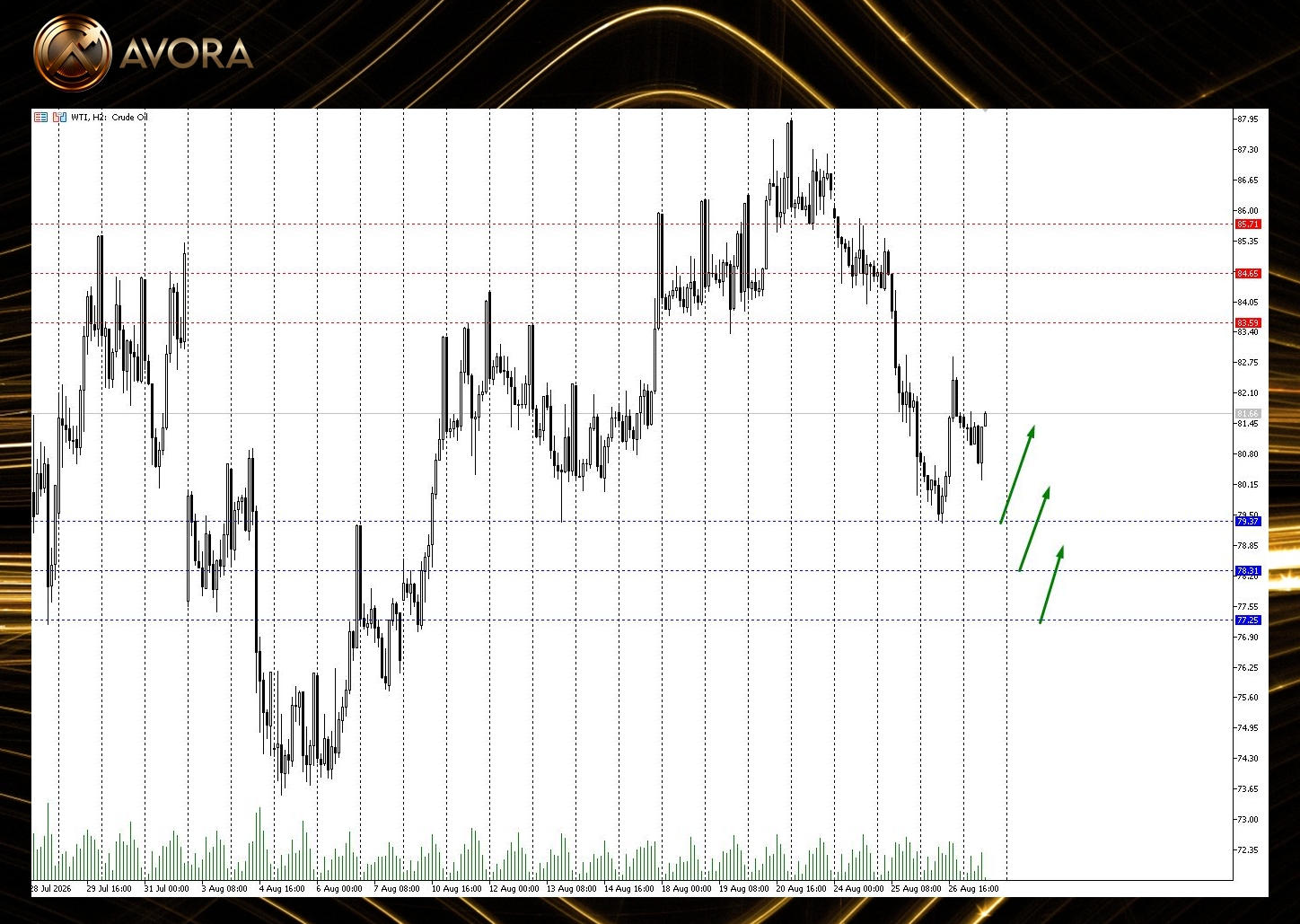
WTI M30. Key potential buying zones: 79.37, 78.31 and 77.25.
What happens to the fundamental
Now oil is between two opposing forces.
On the one hand, a possible normalization of the situation around Hormuz could return part of the supply to the market and reduce the price.
On the other hand, the EIA expects supply disruptions to continue, with U.S. commercial inventories expected to remain below five-year seasonal lows through the end of 2026.
At the same time, OPEC+ has been increasing production by another188 thousand barrels per day, which creates additional pressure on quotes.
Another bearish factor is demand. For the fourth time in a row, OPEC has lowered its forecast for global oil consumption growth for 2026 to580 thousand barrels per day.
Why oil might rise again
The main risk for sellers is geopolitics.
Hormuz remains a critical point in the global oil trade. Any deterioration in negotiations can quickly return the risk premium to the price.
Therefore, the current correction does not look like a clear trend reversal, but likeremoval of the geopolitical premium.
Main scenario
While WTI holds77.25, priority remains with searching for purchases on the decline:
79.37 → 78.31 → 77.25
A return above $84-85 would improve the technical picture and could pave the way for a retest of $87-88.
A breakout of 77.25, on the contrary, will be a signal of a deeper correction.
Main conclusion
Oil is especially sensitive to news right now:negotiations → offer → inventory → price.
Therefore, after a sharp fall, it is better not to chase the movement, but to wait for a reaction in predetermined zones.
The main question is: has the WTI correction ended or will the market once again test buyers at $79–77?